
Whether you’d like a weekend break in one of Andalucía’s famous historic cities or a spectacular national park, or would prefer to pack the car and set off on a leisurely tour of Spain, returning only after you’ve explored every last nook and cranny… the lOO-strong network of internationally acclaimed Paradores — luxury state-owned hotels — are a traveller’s delight.

Magnificent historical sites and breathtaking landscapes – Ronda Parador in Andalucía
The history of Spain’s Paradores dates back to 1910 when, in an effort to create a hotel infrastructure that the country then lacked, the government decided to assign the task to Marquis de la Vega Inclán. The idea was to provide somewhere for travellers to stay that would make use of several of the country’s magnificent historical and cultural sites, and to provide access to some of its most breathtaking natural landscapes.
The innovative project caught the imagination of King Alfonso Xlll, who personally chose the exact site in La Sierra de Gredos (Castilla-León), on which the very first Parador was to be built, and after two years of construction it was opened in 1928.
Shortly afterwards, the Board of Paradores and Inns of Spain was formed and ancient castles, palaces, convents, fortresses and ruins were restored and revamped to offer an unrivalled form of hospitality, where not only are the surroundings irreproachable, but the cuisine is second to none, offering travellers the chance to sample the very best of regional delicacies.
The name Parador comes from the Spanish verb parar — to stop. And that underlines the basic philosophy. Depending on the location and time of year, it may be possible to extend your stay at certain Paradores for a week or more. But with most Paradores strategically situated one easy day’s drive from the next, the idea is to book in for a one to two or maybe three night visit, before moving on to the next intriguing hostelry in the chain.
A travellers delight – The mountaintop Parador of Arcos de la Frontera
Exceptionally, each and every Parador has its own unique identity. You could find yourself sleeping in a Xlll century fortress one day, a Renaissance palace the next, followed by a fairytale castle and a medieval convent. That’s the joy of Paradores… no two are ever the same, although you can always be assured of olde world courtesy, Spanish hospitality and the highest standards of luxury, at affordable prices.
Today, almost 90 years after the launch of the very first Parador, there are around 100 three, four and five-star hostelries stretching from Santander in the north of the Iberian Peninsula, to Málaga in the south… and from Merida in the west, to Aiguablava in the east. With ten new projects currently under construction, or on the drawing board together with Paradores in the Canary and Balearic Islands, as well as the Spanish enclaves of Ceuta and Melilla in North Africa, the opportunities to design your own highly individual Grand Tour are infinite.
Many of the most emblematic Paradores are located in Andalucía, the Costa Calida and the Costa Blanca. Heading west to the province of Cadiz and one of Andalucía’s most charming of whitewashed villages, there’s the impressive mountaintop Parador of Arcos de la Frontera, boasting panoramic views of the breathtaking surrounding landscape and the old town of Arcos. Some 30 kilometres from Sevilla (and a couple of hours from Arcos), is the Carmona Parador, lavishly housed in a XIV century Moorish Alcázar.

Overlooking the bay of Málaga, the city’s landmark Gibralfaro Parador
For nature lovers, one of the most highly recommended Paradores can be found at the heart of the awe-inspiring Cazorla National Park, while in nearby Cordoba, the imposing Parador is a unique construction built on the site of a Moorish summer palace. Málaga’s landmark Gibralfaro Parador overlooks the entire city from its clifftop perch, and heading into the neighbouring province of Granada, a XV century convent is the location of one of Andalucía’s most charming of Paradores adjoining the magnificent Alhambra Palace.
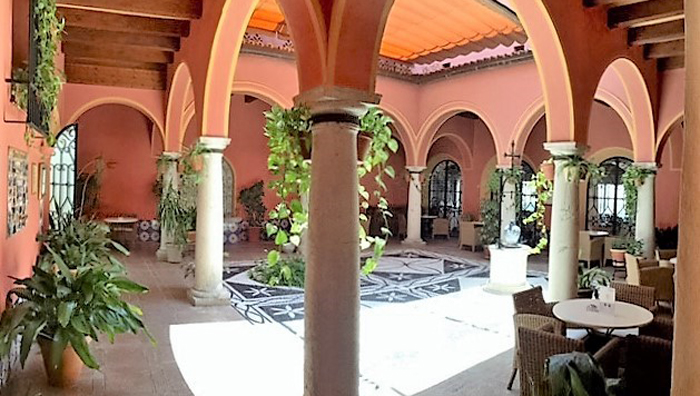
Another exceptionally privileged location is the XII century Moorish fortress high in the mountains of Jaén, while favourites for many are the Parador in Ronda — which is built in the old town hall right next to the city’s landmark New Bridge, which dates back to 1761 — and the XVI century Renaissance Palace in Úbeda (Jaén), where the breathtaking facade hides an atmospheric interior patio, a foretaste of the beauty and splendour that lie within.
For golfers, there is the fabulous El Saler hostelry in Valencia, and the well-known Malaga Golf Parador, while those choosing the Paradores de Vielha or Arties (Pyrenees), can ski in the morning and pamper themselves in the spa in the afternoon. The options are endless, and in addition the Paradores organisation has also put together an enticing series of specialist packages allowing you to explore Green Spain, follow in the footsteps of Quixote, discover the Camino de Santiago, or take the Routes of Wine, Silver and Monasteries, or visit Spain’s World Heritage Sites.